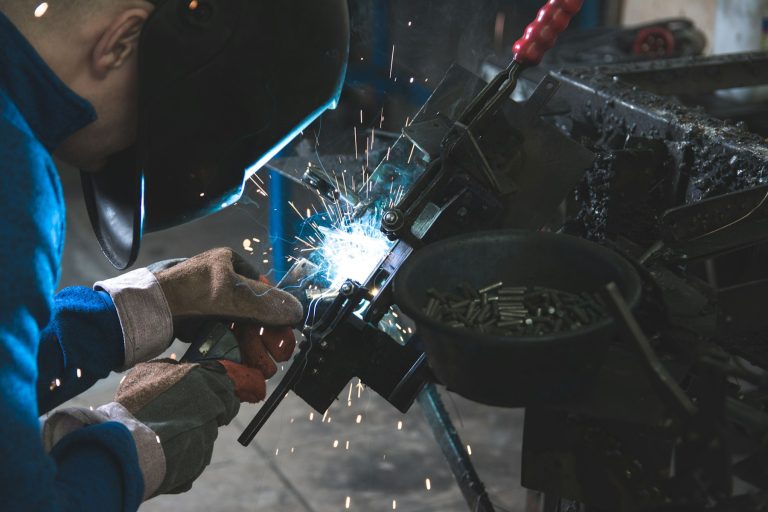
“How much will it cost?” is the first question on almost every call, and for mobile welding the honest answer is: it depends on a handful of things you can usually see in a few photos. Here’s what actually moves the price of an on-site welding job, so you know what to send and where you can save.
1. Travel and setup
Every mobile job starts with loading the truck, driving to you and setting up: machine, gas, leads, screens, fire protection. That time exists whether the weld takes ten minutes or three hours, which is why many mobile welders have a service-call minimum. Jobs closer in, or grouped with other work in the same area, cost less to reach.
2. Access and conditions
A trailer in an open driveway is easy. A cracked bracket behind a machine, under a truck, up a ladder or inside a busy kitchen takes longer to reach, protect and work around. Outdoor TIG work also needs wind protection, and some days it needs rescheduling, because TIG’s gas shield can’t hold in a strong breeze.
3. Prep work
Paint, rust, undercoating, oil and old weld all have to come off before the new weld goes on. On a greasy piece of equipment or an old boat, prep can take longer than the welding itself. You can cut this by cleaning the area beforehand. A pressure wash and degreaser helps a lot.
4. Material and thickness
| Material | What changes the time |
|---|---|
| Mild steel | Usually fastest; prep and paint removal are the main variables |
| Stainless | Lower heat, slower travel, finishing and tint cleanup |
| Aluminum | Heavy cleaning, AC TIG, careful heat control on thin sections |
| Castings | Crack removal, preheat, slow cooling, sometimes multiple sessions |
5. How much welding there is
A one-inch tack on a hinge and a full seam along a tank are different jobs. Length of weld, number of passes and position (flat on a bench versus overhead under a vehicle) all change the time. Overhead and awkward positions are slower and harder.
6. Parts and materials
If the repair needs reinforcement plates, new tube, brackets or hardware, those are added to the cost. Sometimes we build those in the shop first so the on-site visit is shorter.
7. Timing
After-hours, weekend or same-day work to keep a business running may cost more than a scheduled visit. If the repair can wait for a planned window, say so; it often saves money.
How to keep a mobile job affordable
- Send clear photos: a close-up of the damage, a wider shot showing access, and one with a tape measure.
- Clean the area if you can do it safely.
- Clear the space around the weld and move anything flammable.
- Group small repairs into one visit.
- Ask whether the part could come to the shop instead; if it unbolts easily, that’s often cheaper.
The best way to get a fair price is to remove the guesswork. Good photos turn an estimate into a quote.
For more on what to send, read how to get an accurate welding quote, or see how our mobile TIG welding service works.
Frequently asked questions
Is it cheaper to bring the part to the shop?
Usually, if the part comes off easily and fits in a vehicle. Shop work avoids travel and setup time and has better conditions for TIG.
Do mobile welders charge a minimum?
Many do, because travel and setup take time even for a short weld. Ask about it when you request a quote.
Can I get a price over the phone?
A rough idea, sometimes. An accurate quote needs photos, the material and access details, because those change the time involved.